Railway vs Vercel: Choosing Between Containers and Serverless in 2026
Railway and Vercel both let you deploy straight from a Git repository, and getting your first app live takes almost no setup on either one. But that ease hides a real fork in the road. Railway runs your app in a persistent container, like an always-on server. Vercel runs it as serverless functions that spin up, do their job, and disappear. That difference matters more than either platform's onboarding screen lets on.
This comparison walks through where each one fits, what you'll actually pay, and where things tend to go wrong once real traffic shows up.
TL;DR
- Railway gets you from a repo to a running container fast, and it handles databases natively. The tradeoff is usage-based billing that's harder to predict, plus a public status history worth checking before you commit.
- Vercel is built for frontend delivery and serverless compute, and its Next.js integration is hard to beat. But long-running background work still means rewriting around Vercel's own execution primitives.
- If you want persistent backend services, managed databases, and predictable pricing in one platform, Render is worth considering.
Quick Feature Comparison
Feature | Vercel | Railway |
|---|---|---|
Primary Architecture | Serverless functions & Edge CDN | Persistent Docker containers |
Best Used For | Frontend-heavy apps, Next.js, Jamstack | Persistent backend services, APIs |
State Management | Ephemeral (stateless by default) | Persistent state supported |
WebSocket Support | Yes (Native beta via Fluid Compute; capped by function limits) | Yes (indefinite connections) |
Database Hosting | Marketplace integrations only | Native PostgreSQL, MySQL, Redis |
Background Processes | Ephemeral/time-bound workers | Continuous long-running processes |
Reliability | Enterprise-grade edge network | Requires ongoing evaluation for production |
Pricing Model | Tiered plans | Usage-based (vCPU + RAM) with minimums |
How to weigh the tradeoffs
For production apps, architectural fit usually matters more than first-deploy convenience. Vercel is built for delivering frontend assets and running short-lived backend functions at the edge. Railway takes a different approach, keeping your services running in persistent containers.
So the real question comes down to your backend. Can it live within serverless limits, or does it need always-on compute, background processes that never stop, or raw TCP connections?
Answering that starts with understanding what each platform actually does.
What is Railway?
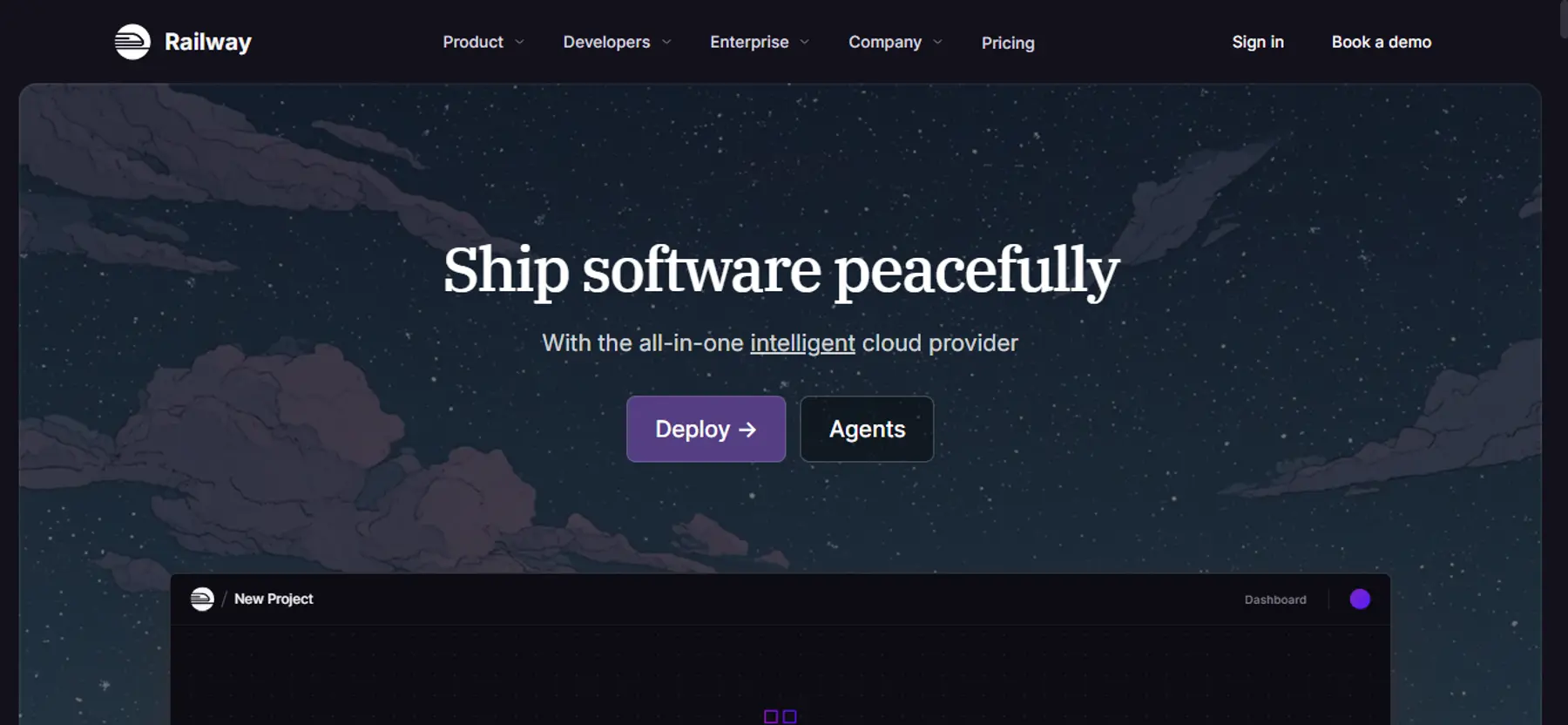
Railway is a container-based platform that deploys applications and databases from a code repository or Docker image. If you don’t have a Dockerfile, it builds from source using Railpack and supports long-lived processes, WebSockets, and raw TCP connections.
Its real strength is how little friction there is between writing code and seeing it live. Provisioning, environment variables, builds, and logs all live in one dashboard, and pushing to git is what triggers the deploy. That’s what makes it fast for you to go from an empty repository to a running app.
Pricing is usage-based. The Pro tier has a $20 minimum monthly usage commitment, and compute gets billed separately based on how much vCPU and RAM you actually use.
What is Vercel?
Vercel is a frontend-first platform optimized for static assets, Jamstack sites, and applications built with Next.js. Push to a Git repo, and it deploys straight to a global edge CDN.
Backend logic runs differently here. It runs in serverless environments with strict timeouts, and Vercel doesn’t support persistent servers or arbitrary TCP connections. It did add native WebSocket support recently, but those connections are still capped by the same function duration limits.
Where Vercel stands out is frontend performance. If your backend can live within stateless, short-lived functions, its edge delivery and Next.js integration are hard to match.
Pricing is tier-based, starting at $20 per user per month on Pro, plus usage-based charges once you're past the included credit.
Where is Railway stronger than Vercel?
Railway's container model handles workloads serverless simply can't.
Persistent processes and indefinite connections
Railway containers behave like always-on servers, so background processes can run indefinitely and any TCP-based protocol works. Vercel's native WebSockets, by contrast, are still tied to the function's maximum execution duration.
If you need uninterrupted real-time connections, background queues, or protocols beyond HTTP, Railway's architecture fits better.
Native database services
Railway runs PostgreSQL, MySQL, and Redis natively, with automated snapshots. Vercel, on the other hand, doesn’t provide first-party database hosting. You have to rely on marketplace integrations like Neon for Postgres and Upstash for Redis, which means an extra vendor in the stack.
Build time flexibility
Vercel caps build duration at 45 minutes. Railway's containers don't have that ceiling. For large applications or complex workloads with long build processes, Railway offers more flexibility.
Where is Vercel stronger than Railway?
Vercel's focus on frontend delivery creates advantages for many use cases.
Frontend performance and edge delivery
Vercel's edge CDN is designed for high-performance static asset delivery. If your app is frontend-heavy, especially with Next.js, you get strong defaults for caching, image optimization, and global distribution.
Railway has added its own CDN caching, currently in beta and free on all plans. It’s worth checking Railway's docs for current maturity before relying on it for latency-sensitive traffic.
Next.js integration
Vercel built Next.js, and it shows. Build optimizations, incremental static regeneration, and other framework-specific features just work with no extra setup. Next.js apps generally need less configuration on Vercel than on other platforms.
Free tier for non-commercial projects
Vercel's Hobby plan is free for non-commercial projects, with generous enough limits to actually build on.
Railway's free option is thinner on compute. It offers a 30-day trial with $5 in credit, then a permanent Free plan with just $1 of credit a month. This is enough to keep something small alive, but it’s not enough for continuous production traffic.
Where does Railway introduce production risk?
Railway's speed comes with tradeoffs once a service is in production.
Reliability requires ongoing evaluation
Railway publishes its status history at status.railway.com. If you’re considering Railway for production workloads, review recent incident patterns across deployments, builds, dashboard access, logs and metrics, edge networking, and workload connectivity.
What matters more than any single incident is how widely failures spread across those systems. That's the pattern worth watching before committing a production workload.
Deployment throughput depends on plan and platform load
Railway's deployment docs state that during a high-traffic pause, new deployments are queued instead of processed immediately, while Pro users can bypass the queue.
For production environments, that turns deployment priority into a question of which plan you're on. Worth weighing directly if you need changes to ship on demand.
Database services require more operational work
Railway's native database services include automated snapshots, and connection pooling is now built into the dashboard as well. Adding PgBouncer no longer means standing up a separate service yourself. What's still on you is sizing the pool against your connection limits and tuning performance.
Pricing is harder to forecast for steady workloads
Usage-based billing can work well for uneven workloads. For always-on services, it is less predictable than fixed container pricing as costs accumulate with compute usage and egress.
Where does Vercel introduce constraints?
Vercel's serverless model creates hard limitations for certain workloads.
No persistent state or long-running processes
Standard Vercel functions are still stateless and ephemeral, and you can't run a raw TCP socket server inside one. Vercel now covers durable state and background work with its own primitives, like Workflows, Queues, and Sandbox.
But using them means rewriting that logic against Vercel's execution model. Railway just runs your existing long-lived process as-is, no rewrite required.
Timeout limits on backend logic
Serverless function timeouts vary by plan. While Fluid Compute makes Vercel functions run longer and more efficiently, they're still event-driven with a 30-minute ceiling. Railway's containers stay on indefinitely, with no such limit.
Private networking requires Enterprise
Private networking via Secure Compute is available on Enterprise today. Pro access has been on Vercel's roadmap, but it’s worth checking official documentation for current availability before you plan around it.
When does sticking to Vercel make sense?
Vercel still works for:
- Frontend-heavy applications where backend logic fits within serverless constraints
- Next.js projects that benefit from tight framework integration
- Static sites and Jamstack applications served via edge CDN
- Vercel is good for Teams comfortable rewriting background work around Vercel's own execution model rather than running it as a long-lived process.
When does sticking to Railway make sense?
Railway is good for:
- Production-grade full-stack monoliths and microservices
- Teams that want private internal networking between services like PostgreSQL, Redis, or RabbitMQ
- Applications that need persistent background processes or arbitrary TCP connections
- Teams comfortable with usage-based billing and owning more operational responsibility
When should you consider migrating?
For Vercel, the signal is usually an architectural constraint:
- Your backend logic keeps hitting timeout limits
- You need custom TCP protocols, or you don't want to rewrite background work
- Managing multiple external services for data and compute has become coordination overhead
- Private networking is a requirement, but Enterprise pricing is not viable
For Railway, the signal is usually production friction:
- Queued deploys or delayed builds have affected a release window
- The status-history pattern is now part of your platform risk review
- Compute spend is getting harder to forecast for always-on workloads
- The database setup still asks your team to make more reliability decisions than it wants to own
What does Render offer that Railway and Vercel do not?
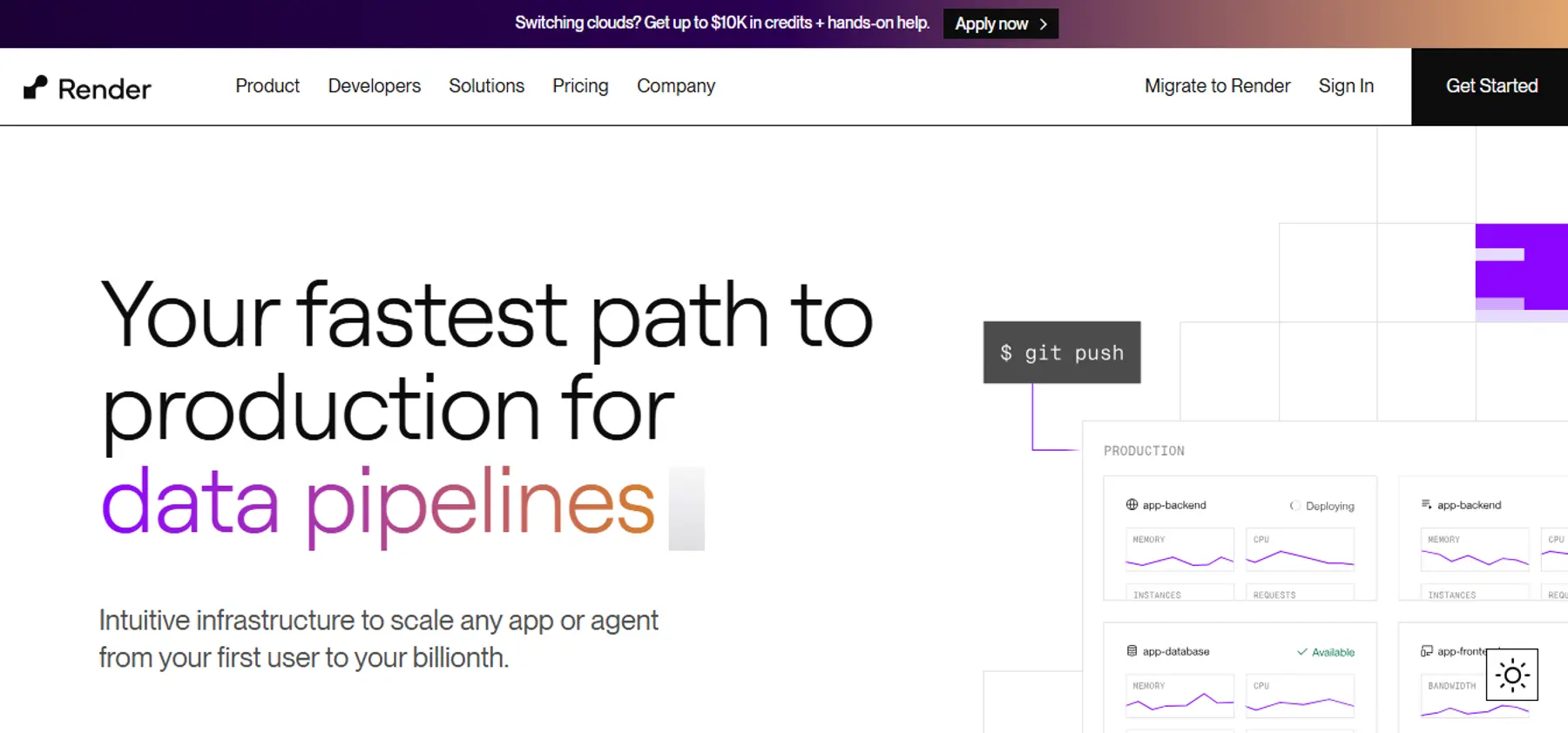
Render combines web services, background workers, cron jobs, managed Postgres, and Redis-compatible key-value storage in one control plane. If your main friction with Vercel is serverless constraints, or if Railway’s reliability and operational overhead are a concern, that integration is the practical difference.
Render's Pro workspace plan includes a base fee plus compute, and its Standard web service at 1 vCPU/2 GB is available at a fixed rate of $25/month.
Features worth evaluating for production workloads:
- Persistent web services with configurable HTTP request timeouts
- Background workers for long-running tasks and async processing
- Render Workflows for durable background jobs that can run for hours without third-party orchestrators
- Zero-downtime deploys for supported services
- Managed Postgres with point-in-time recovery and high availability options
- Private networking for services in the same region and workspace
- Native WebSocket support
Render also publishes its security and compliance posture, including SOC 2 Type 2 and HIPAA support.
For a deeper analysis, explore the official Render vs Vercel and Render vs Railway comparison pages.
Conclusion
The choice between Railway and Vercel is largely architectural. Vercel excels at frontend delivery and serverless compute for applications that fit its model. Railway offers the flexibility of persistent containers for workloads that need long-running processes, WebSockets, or native database services.
Both platforms have tradeoffs. Vercel's serverless model still means rewriting long-running logic around its own execution primitives. Railway's usage-based billing and operational model introduce production considerations that grow as workloads become more critical.
If you want persistent backend services, managed databases, and predictable pricing in one place, Render is the natural next step.
See the Render pricing page for full details.