Migrating production infrastructure? Get up to $10K in migration credits.
Apply nowMigrating production infrastructure? Get up to $10K in migration credits.
Apply nowconst agentLoop = task({ name: 'agentLoop' },async (ctx: TaskContext, userInput: string, conversationContext: object) => {const actions = await callLlm(userInput, conversationContext)// Chain a task run for each planned action, in parallelconst results = await Promise.all(actions.map((action) => ctx.run(execute, action)))// Combine results into a coherent responsereturn await ctx.run(synthesize, userInput, results)})const execute = task({ name: 'execute' },(_ctx: TaskContext, action: { name: string }) => {const handler = getHandler(action.name)return { action: action.name, result: handler(action) }})const synthesize = task({ name: 'synthesize' }, ...)
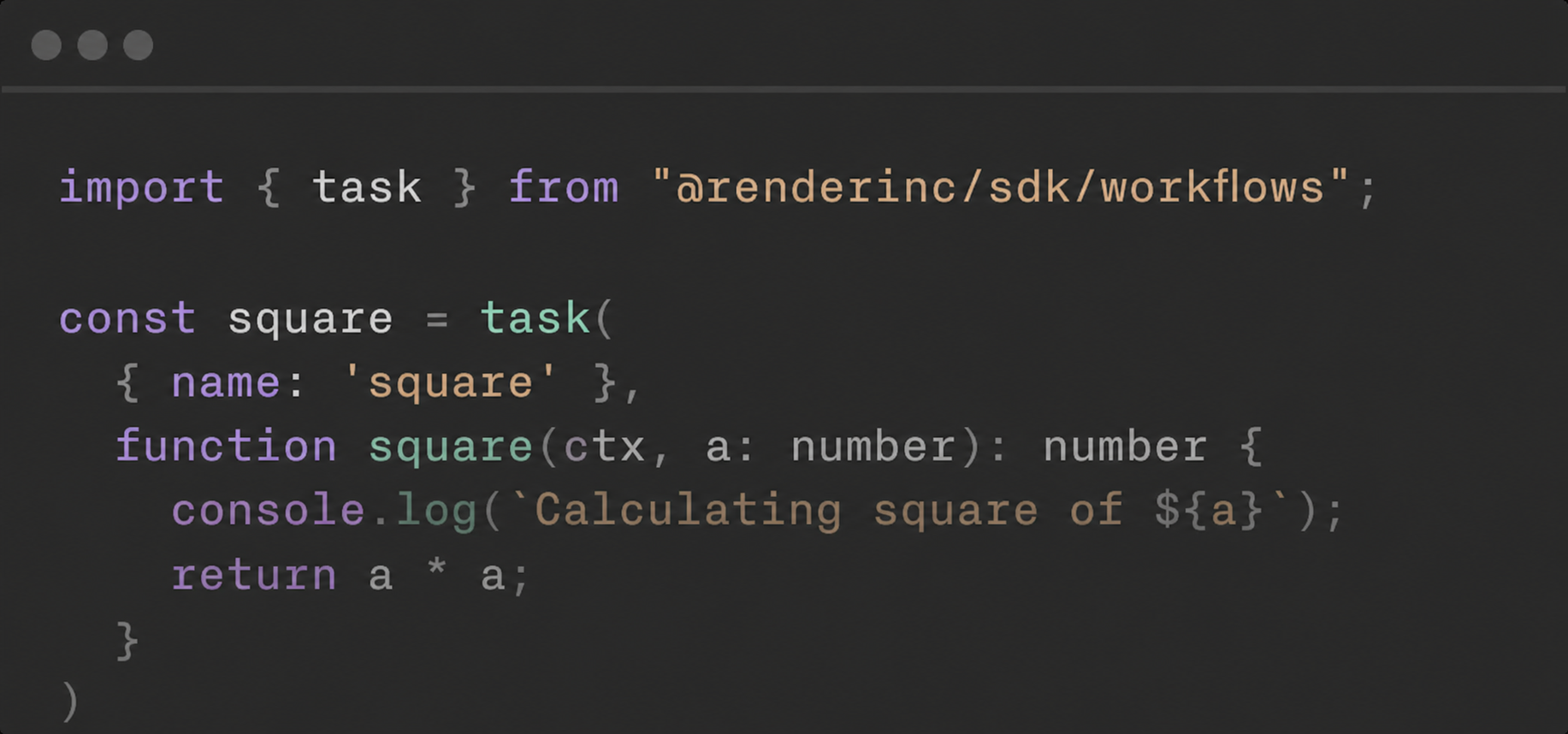
Make any function an async task that runs in its own ephemeral container.


Configure retry behavior for each task to handle transient failures automatically.


Make crashes inconsequential by resuming workflows right where they left off.


Render starts task compute in milliseconds to keep your experiences responsive.


Use up to 10,000 CPUs per workflow, without managing worker pools or standing up queuing systems.


Run compute-intensive tasks on larger compute plans for up to 24 hours.


See a unified history of active, queued, and completed task runs.


Analyze performance and reliability across time spans.


Inspect runs to optimize and debug.

“Render Workflows completely solved our scaling and simultaneous usage issues. They give us a reliable execution layer outside our core application for compute-heavy jobs. It’s been invaluable to have great visibility into runs and failures without building custom orchestration.”