Migrating production infrastructure? Get up to $10K in migration credits.
Apply nowHow Axel keeps its lean team focused on finding better travel deals
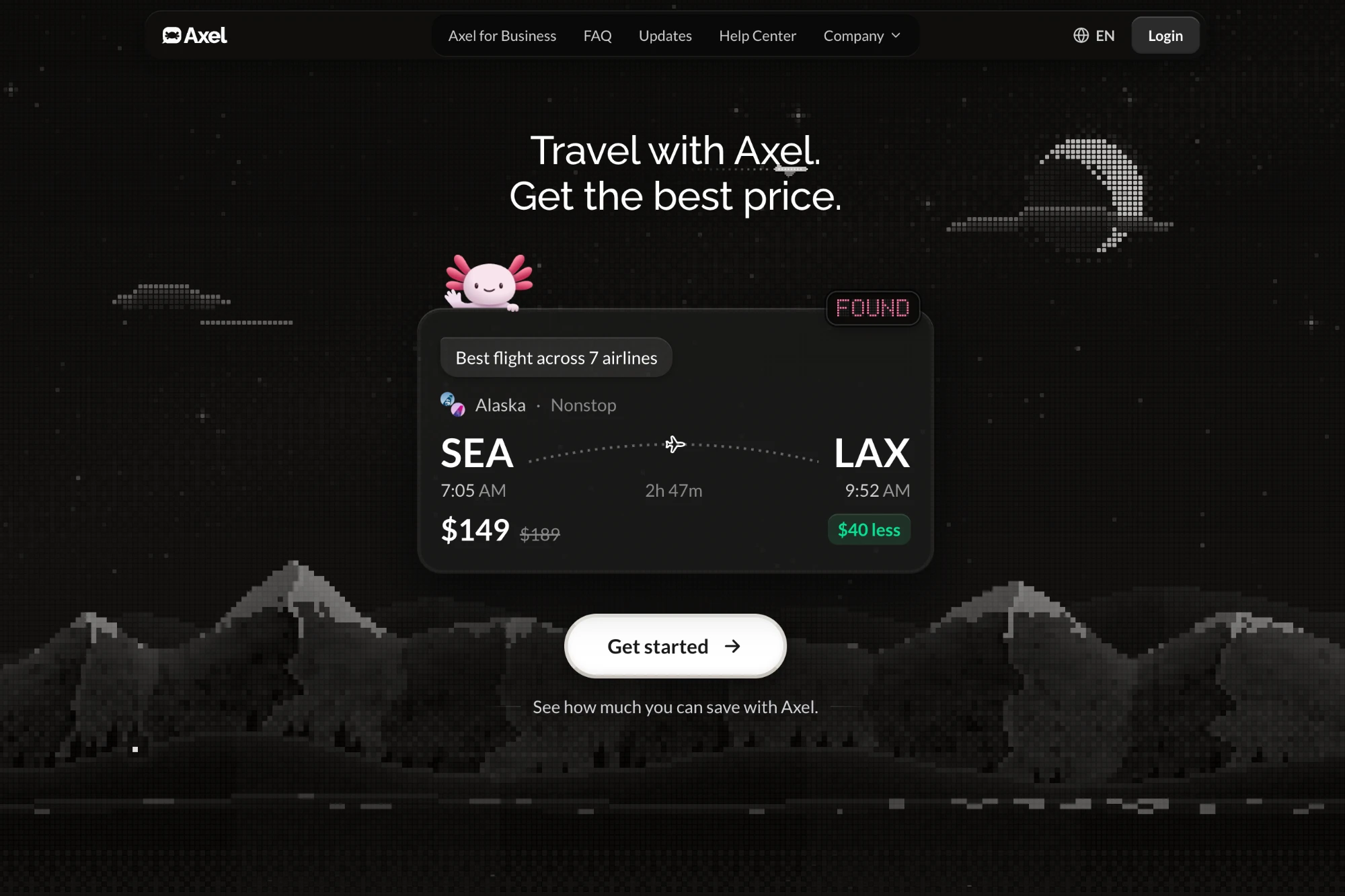

Axel helps travelers get better flight and hotel deals than they can find on their own. Render helps its lean team improve the product without taking on full-time infrastructure work.
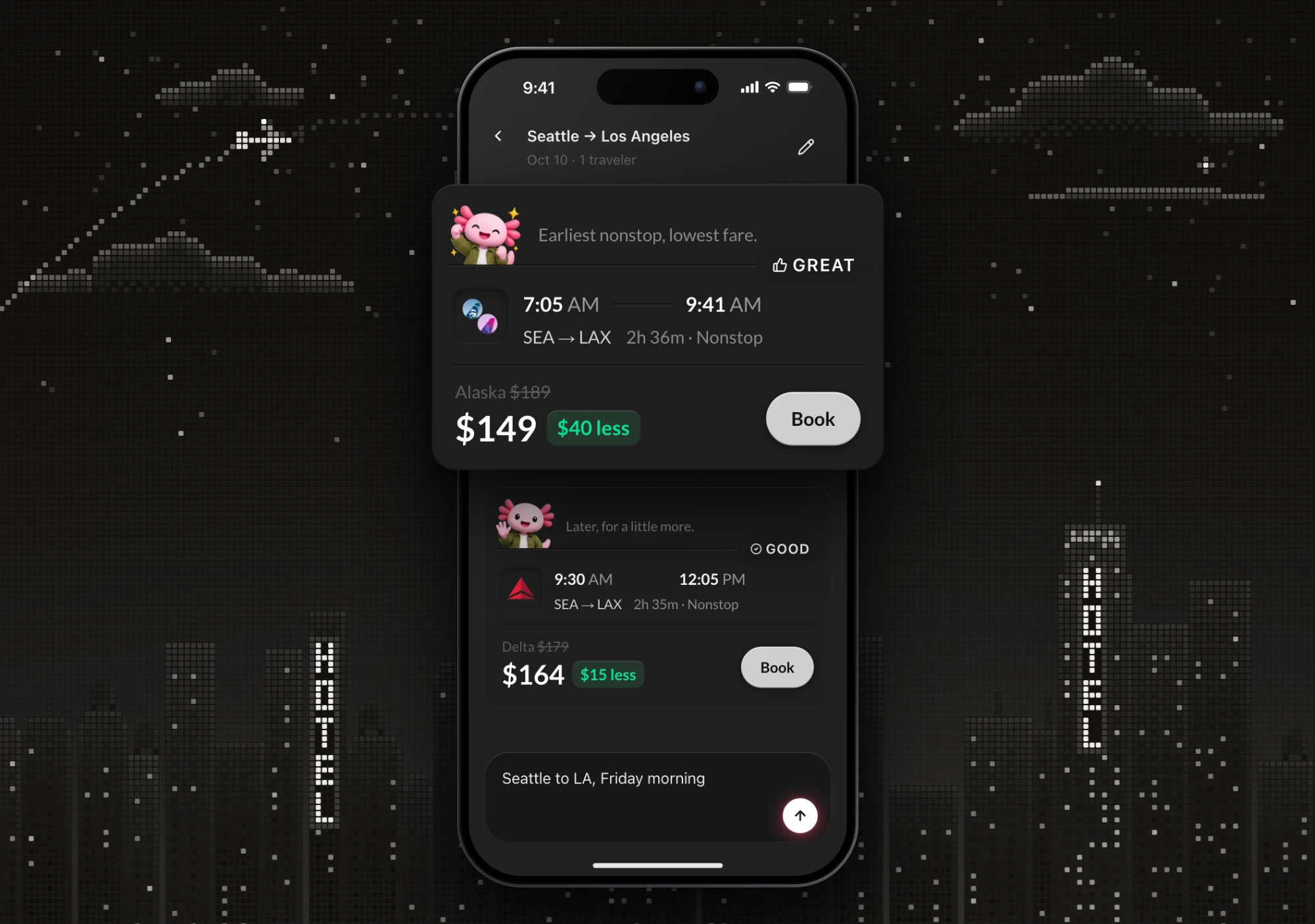
Axel is an AI-powered travel agent that helps travelers search, compare, book, and monitor flights and hotels. Users start with a natural-language request like “I want to go from Los Angeles to New York next Friday.” Axel asks follow-up questions, combines the conversation with traveler preferences and current market data, and returns relevant options. If the timing or price isn’t right, it can keep monitoring the trip and follow up later, so travelers don’t have to keep checking prices themselves.
Travelers can ask Claude or ChatGPT to search Axel’s live flight prices without setting up a connector. They can compare flight options within their conversation, then continue in Axel to book.
Axel grew out of industry-veteran Stephen Grabowski’s conviction that a consumer product would need to be fundamentally better than existing booking tools to break through. After years of building travel technology, he had resisted entering the market. Large language models are what finally changed what his team could build and gave them a novel new way to approach travel search and booking.
Axel has crossed $30 million in annualized gross bookings, and continues to grow rapidly. As the product has grown, Render has helped the team deploy and scale it without turning infrastructure into a full-time job.
Focus where it matters
Grabowski’s infrastructure philosophy starts with his team’s attention. “I place a high premium on our team’s mental bandwidth,” he says. He wants engineers focused on improving how Axel finds and surfaces travel options rather than managing infrastructure that a software provider can handle.
Gordian Software, Axel’s parent company, has long used Heroku and AWS at significant scale, and it continues to rely on AWS for other workloads. Axel presented a different challenge: the team was testing several consumer travel concepts and needed to build and evaluate them quickly without spending developer time fine-tuning infrastructure.
As Axel began testing those concepts, the team chose Render to spin up services for each experiment and deploy them from a shared codebase. Render let the team test new capabilities, observe how travelers actually responded, and quickly move on from ideas that did not work without turning each experiment into an ops project.
Render began as the infrastructure for Axel’s experiments. When Axel emerged as the concept travelers wanted, the team could comfortably keep building on the same platform.
“Render was a really great fit for allowing us to really easily spin up and start to experiment,” Grabowski says. “It definitely allowed us to experiment quickly at first, and then it was also great for the product.”
From experimentation to scale
Once Axel emerged as the product travelers wanted, the team had to turn a promising experiment into a production system. Each request combines a traveler’s conversation and preferences with live flight and hotel data, tools, and supplier content. Axel’s central reasoning model uses that context to return text, flight and hotel results, maps, and other rich content.
If a traveler needs more time, Axel can keep working. Scheduled jobs revisit recent conversations over several days, refresh market data, and decide whether a follow-up would help. On Render, the team deploys the services and cron jobs behind that system independently from one monorepo. Shared schemas and tests keep the pieces coordinated while the team iterates.
As bookings grew, the team increased compute. “It’s been really smooth to scale it,” Grabowski says.

Giving a lean team more leverage
With Axel gaining traction, Grabowski wants to improve the product rapidly while keeping the team lean and efficient. The team relies heavily on coding agents to build software and increasingly uses them to manage Render resources. “I try to spend most of my time either talking to customers and figuring out what the next high-leverage things to build are, or having agents build stuff,” Grabowski says.
The team combines the Render Dashboard with Terraform for repeatable environments. The Render MCP server gives agents a structured interface for managing resource changes.
In one example, a system Grabowski had built used a Render cron job to analyze signals from customer conversations. When newer language models made the system worth revisiting, Grabowski simply asked an agent to refresh it. Through the Render MCP server, the agent turned off the old cron jobs, deployed an improvement, and reported back when the work was complete.
Grabowski set the goal, and his coding agent handled the Render changes. The team kept its attention on improving Axel’s search and booking experience and deciding what to build next.
Scaling without losing focus
As Axel grows, its infrastructure will need to keep pace with a more complex product and changing demand. The team plans to explore autoscaling, Render Workflows for multi-step agent work, and Blueprints to keep its infrastructure defined and reproducible as it expands.
Together, those capabilities would extend an operating model already underway. Axel is giving coding agents more responsibility for routine Render changes through the Render MCP server, while the team retains visibility and repeatability through the Render Dashboard and Terraform.
For Grabowski, infrastructure should solve proven problems so his team can spend its time helping travelers find better deals. Render gives Axel a way to preserve that focus as the product grows.

