Vercel Alternatives for Full-Stack and Backend Workloads
TL;DR
-
The best Vercel alternatives depend on your backend architecture. Render works best for persistent web services, background workers, and private networking. For real-time WebSockets requiring global edge latency, Fly.io is ideal. Northflank provides advanced Kubernetes abstractions and BYOC. DigitalOcean, AWS, or GCP suit environments needing broad cloud primitives at scale. Railway remains an option for hobby projects and early-stage iteration only, as it is unsuitable for production-grade applications due to architectural limitations.
-
Workload archetypes that trigger a backend migration include serverless function duration limits (a 300-second default, rising to an 800-second maximum on Pro and Enterprise plans), the lack of native persistent background workers, real-time WebSocket limitations, and the need for managed databases on private networks.
-
The most practical migration path is a "hybrid split" strategy: keep your frontend on Vercel for edge delivery and route heavy APIs, background tasks, and databases to a persistent cloud platform.
-
Execute a migration with minimal downtime by decoupling your API to establish internal DNS, externalizing long-running tasks to queues, migrating stateful WebSocket connections to persistent processes, and provisioning managed databases on a private network.
Vercel is a strong platform for frontend frameworks and edge delivery. Deploying a Next.js application provides teams with integrated tooling and a globally optimized content network.
Friction begins when the backend half of a full-stack application no longer fits an ephemeral, request-driven model. This turning point often manifests as a specific technical failure: an AI inference call exceeding a timeout limit, a stateful WebSocket server dropping connections, or unpredictable cost spikes from usage-based billing.
This guide breaks down the triggers pushing teams away from frontend-first hosting, explores the architectural archetypes demanding a different compute model, and evaluates the platforms best suited for persistent backend workloads.
Which workload archetypes trigger a backend migration?
The search for backend hosting alternatives is rarely about the frontend; it is about the compute model. Vercel's request-driven edge execution sequence is bound to a single HTTP lifecycle. Although powerful for many API routes, this model shows its limits when an application's architecture evolves.
The following triggers are diagnostic signs that a backend workload has outgrown an ephemeral, request-driven paradigm and requires a persistent compute platform.
Long-running APIs and serverless function timeout limits
A common migration trigger is a FUNCTION_INVOCATION_TIMEOUT error. Vercel has a 300-second default across all plans and an 800-second maximum for Pro and Enterprise. Supported Node.js and Python functions on Pro and Enterprise can also opt into a 1,800-second extended maximum, currently in beta. The higher limits are therefore unavailable on the Hobby plan and are not supported across every runtime. Any invocation exceeding its configured limit still terminates with an HTTP 504.
For processes that run beyond these limits, coupling long-running backend execution to a synchronous HTTP client request is an architectural anti-pattern. Client browsers and network proxies will reliably drop connections held open for minutes.
The correct engineering solution is adopting asynchronous patterns. Vercel Workflow offers a durable execution engine for orchestrating tasks over long periods, and Vercel Queues supports asynchronous processing with retries and delivery guarantees. A more direct approach for workloads that require an always-on process uses a platform with native background workers. Alternatively, a persistent container on Render or DigitalOcean can poll a task queue continuously.
This architecture is bounded by system resources rather than HTTP limits, allowing the API to immediately return a job ID while a dedicated worker handles the task asynchronously.
Persistent background workers and task queues
Many essential backend workloads fall outside the HTTP request-response cycle:
- Queue consumers processing jobs
- Media transcoding services
- Periodic AI task execution
- Continuous third-party API polling
These workloads require different patterns. Vercel Queues and Workflow can support asynchronous and durable tasks, while continuously running polling loops or long-running daemons require persistent processes.
The need for an always-on process triggers a migration to platforms with first-class support for persistent background workers. These services run in dedicated containers decoupled from the web request lifecycle, allowing them to process tasks from a queue indefinitely.
WebSockets and real-time state limitations
Real-time communication demands a persistent process capable of maintaining state. Vercel introduced native WebSocket support, but it carries strict constraints. Connections remain bound by function duration limits and lack built-in primitives for presence, which is essential for tracking connected users.
Platforms using virtual machines or managed containers, such as Render or Fly.io, allow a Node.js, Go, or Rust server to accept and hold thousands of concurrent WebSocket connections indefinitely. This architecture provides the stability and stateful environment required for scalable real-time applications.
Private networking and managed databases
Vercel does not natively host databases, relying instead on marketplace integrations with providers like Neon and Upstash. API calls from Vercel Functions to these databases must traverse the public internet. This introduces latency and security concerns unless you use a top-tier Enterprise plan with Secure Compute VPC peering.
The more direct solution moves backend services to a cloud platform offering natively managed databases, such as PostgreSQL and Redis-compatible stores. Platforms like Render provide a zero-configuration private network, allowing compute instances and databases to communicate internally for lower latency and enhanced security.
Custom runtimes, AI workloads, and usage-based billing
Framework-defined infrastructure restricts the use of custom Linux dependencies and non-standard language runtimes. Vercel's Large Functions permit 5GB bundles for Python and Node.js, but a Docker-based deployment on a container-defined cloud platform provides full OS-level dependency control.
This control is necessary for AI workloads requiring specific system libraries or GPU drivers. When using Python for these workloads, Render also provides native Python runtime support as an alternative to Docker. Refer to documentation on when to choose Docker vs. native runtimes.
AI agent workflows that execute untrusted, AI-generated code necessitate strictly isolated microVM sandboxes, such as Kata Containers or Firecracker, to operate safely. For bursty, on-demand GPU inference, teams often look to specialized platforms like Modal or Northflank to handle these compute-intensive tasks.
The cost model presents another significant migration trigger. Vercel bills for function invocations, Active CPU, and Provisioned Memory. With Fluid compute, Active CPU is billed only while code is executing. Time spent waiting on I/O does not count as Active CPU time, although Provisioned Memory is billed for the duration of the invocation.
This multi-dimensional usage model can make bills harder to forecast during traffic spikes. Moving to fixed-resource compute tiers on a platform like Render can make baseline compute costs more predictable, although bandwidth, storage, databases, scaling, and other metered services can still vary.
What is the "hybrid split" migration strategy?
The most practical, lowest-risk migration path is a "hybrid split" deployment pattern. This strategy avoids a complete rip-and-replace, allowing you to retain Vercel's edge delivery for your frontend while addressing your backend's architectural needs.
In this model, you keep the Next.js frontend and its associated edge caching on Vercel. Simultaneously, you move the API, background workers, and databases to a persistent cloud platform like Render.
Establishing a clear boundary between the two is critical. Frontend-to-backend calls from the Vercel app to the backend platform must use a public, secured API endpoint. For communication between services on the backend platform, use internal DNS to keep traffic off the public internet.
This approach extends to preview environments. A true full-stack preview spins up the frontend code alongside the corresponding API and a seeded database. Although this provides a complete testing environment, it requires manual CI/CD configuration to orchestrate the build sequence: you must provision the backend first to generate the URL before triggering the Vercel frontend build process.
Quick comparison: alternatives at a glance
This table provides a scannable overview to help you shortlist alternatives based on your primary workload.
Alternative name | Best for | Compute model | Main differentiator vs Vercel |
|---|---|---|---|
Render | Hybrid split and full-stack migrations | Persistent containers | Unified platform with native workers and private networking |
Fly.io | Global, latency-sensitive applications | Edge-native microVMs | Global Anycast routing for deep edge latency optimization |
Northflank | Enterprise and advanced AI workloads | Advanced Kubernetes abstractions | Bring Your Own Cloud (BYOC) and GPU support |
DigitalOcean, AWS, GCP | Extreme scale and complex compliance | Broad cloud primitives | Exposes raw networking and compute primitives for flexibility |
Railway | Hobby projects and prototypes | Persistent containers | Fast, container-driven canvas for rapid iteration |
Which Vercel alternative is right for your backend?
Choosing the right alternative depends on the workload archetype that triggered the migration. This overview frames each competitor based on its best-fit use case.
Render: the multi-service cloud platform
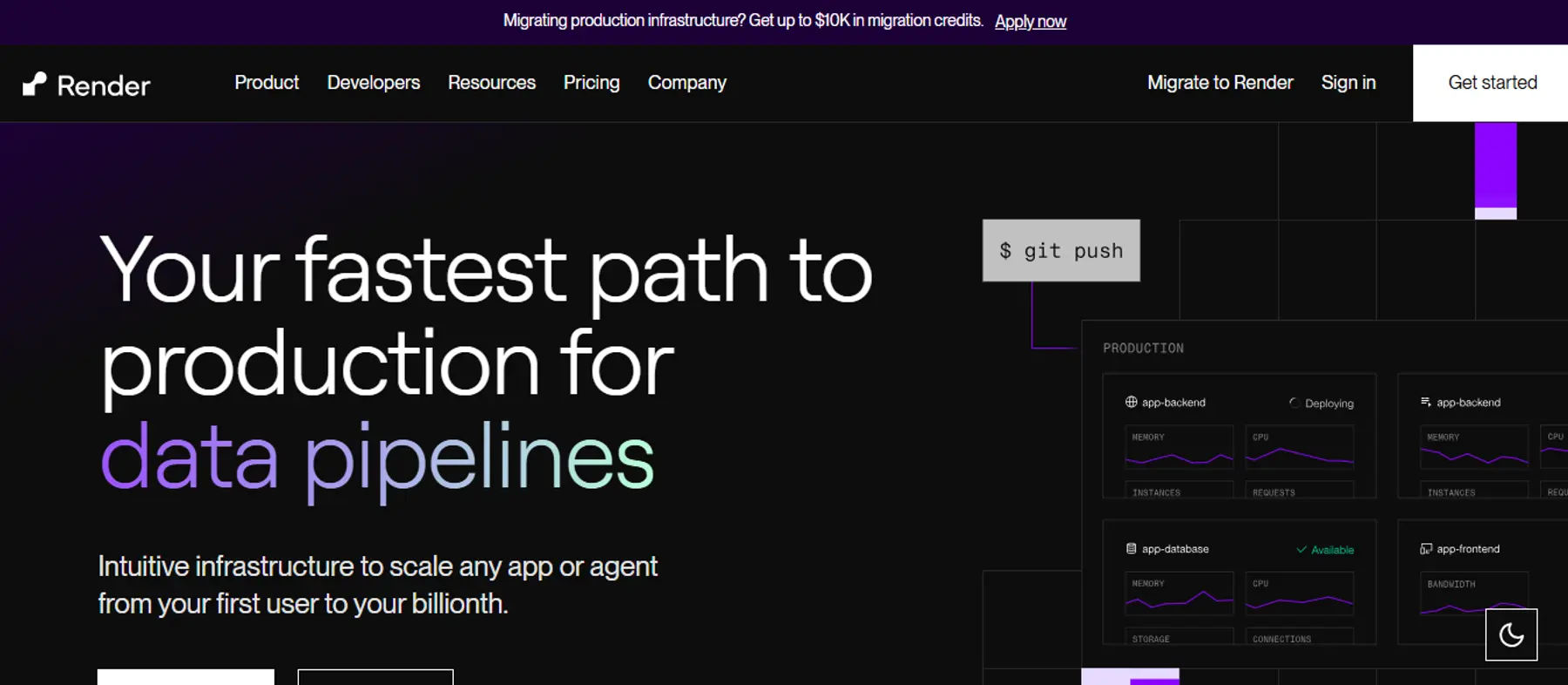
Render is a strong option for teams adopting the hybrid split or migrating their entire stack. It offers a balanced, unified platform with the following capabilities:
- Persistent web services
- First-class background workers
- Managed PostgreSQL
- Render Key Value (Redis®-compatible)
- Zero-configuration private networking
Render provides native support for long-running processes through its background workers and Render Workflows, which runs long tasks with managed queuing and retries, with runs of up to 24 hours. Although web services support 100-minute request timeouts, the platform's architecture correctly positions asynchronous workers as the solution for long tasks.
It offers native Python runtimes and full Docker support for platform independence, which is necessary for AI workloads. Full-stack Preview Environments automatically spin up all components of an application, though cross-platform previews with Vercel require extra CI/CD configuration. Render's predictable, fixed-tier pricing model prevents traffic-induced cost spikes.
Fly.io: edge-native virtual machines
Fly.io is a strong option for latency-sensitive, global applications requiring deep edge optimization. It is better suited than other platforms when global Anycast routing is your primary architectural requirement.
However, its CLI-first approach and manual configuration for networking and volumes demand higher operational expertise from the development team.
Northflank: BYOC and advanced Kubernetes abstractions
Northflank targets enterprises needing strict data sovereignty, advanced Kubernetes features, and heavy AI/GPU workloads. The standout feature is Bring Your Own Cloud (BYOC) capability, allowing deployments on your own AWS, GCP, Azure, or Oracle infrastructure using isolated microVM sandboxes and Kubernetes abstractions.
It provides heavily managed databases and secure environments for running untrusted AI-generated code. The tradeoff is balancing managed convenience and Kubernetes-level complexity.
DigitalOcean, AWS, and GCP: broad cloud primitives
For applications requiring extreme scale, complex compliance, or deep integrations with a broader cloud ecosystem, major cloud providers are a logical choice. Services like AWS ECS/Fargate and GCP Cloud Run offer powerful destinations for containerized workloads.
DigitalOcean's App Platform is a fully managed middle ground. In contrast, major cloud providers like AWS and GCP expose raw cloud primitives:
- VMs and managed containers
- IAM roles
- Custom VPC subnets
- Load balancers
This provides immense flexibility at the cost of a significantly steeper learning curve.
Railway: for hobbyists and prototypes
Railway is a fast, container-driven platform excellent for rapid iteration and multi-service architectures during the early stages of a project. It offers a flexible canvas supporting multi-service architectures outside of serverless constraints.
However, Railway is unsuitable for production-grade applications due to architectural limitations. It remains appropriate for hobby projects, prototypes, and early-stage iteration only. Its granular, metered usage billing requires careful monitoring to prevent unexpected cost spikes.
Conclusion
The hybrid split lets you keep Vercel's edge delivery for your frontend while securing the persistent compute your backend needs to scale.
Matching your workload archetype, whether it requires background workers, WebSockets, or private databases, to a container-defined cloud platform solves the timeout constraints and unpredictable cost issues inherent in a purely serverless model.
Frequently Asked Questions
Redis is a registered trademark of Redis Ltd. Any rights therein are reserved to Redis Ltd. Any use by Render is for referential purposes only and does not indicate any sponsorship, endorsement or affiliation between Redis and Render.