Migrating production infrastructure? Get up to $10K in migration credits.
Apply nowThe invisible infrastructure behind Every’s AI-pilled team


Every is a media and software company that simultaneously builds and writes about what's next in technology. They produce a deeply researched newsletter, offer AI training and consulting, and have created products like Cora, Spiral, Sparkle, Monologue, Proof, and Plus One. For Every’s AI-pilled team, infrastructure doesn’t just keep the lights on; it’s an invisible accelerator for how they build.
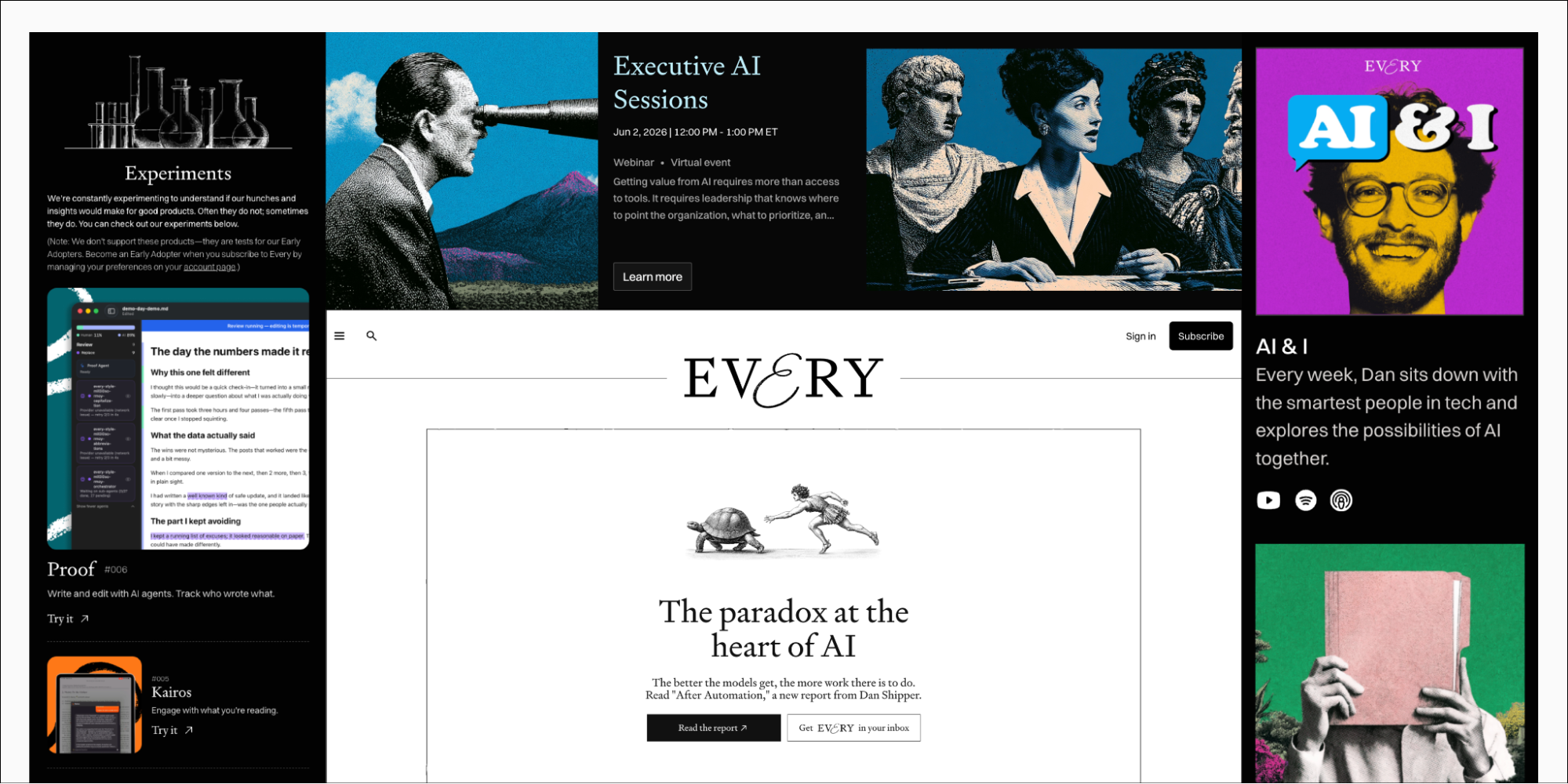
Dan Shipper, CEO and Cofounder of Every, describes the company as an institution built on playing around.
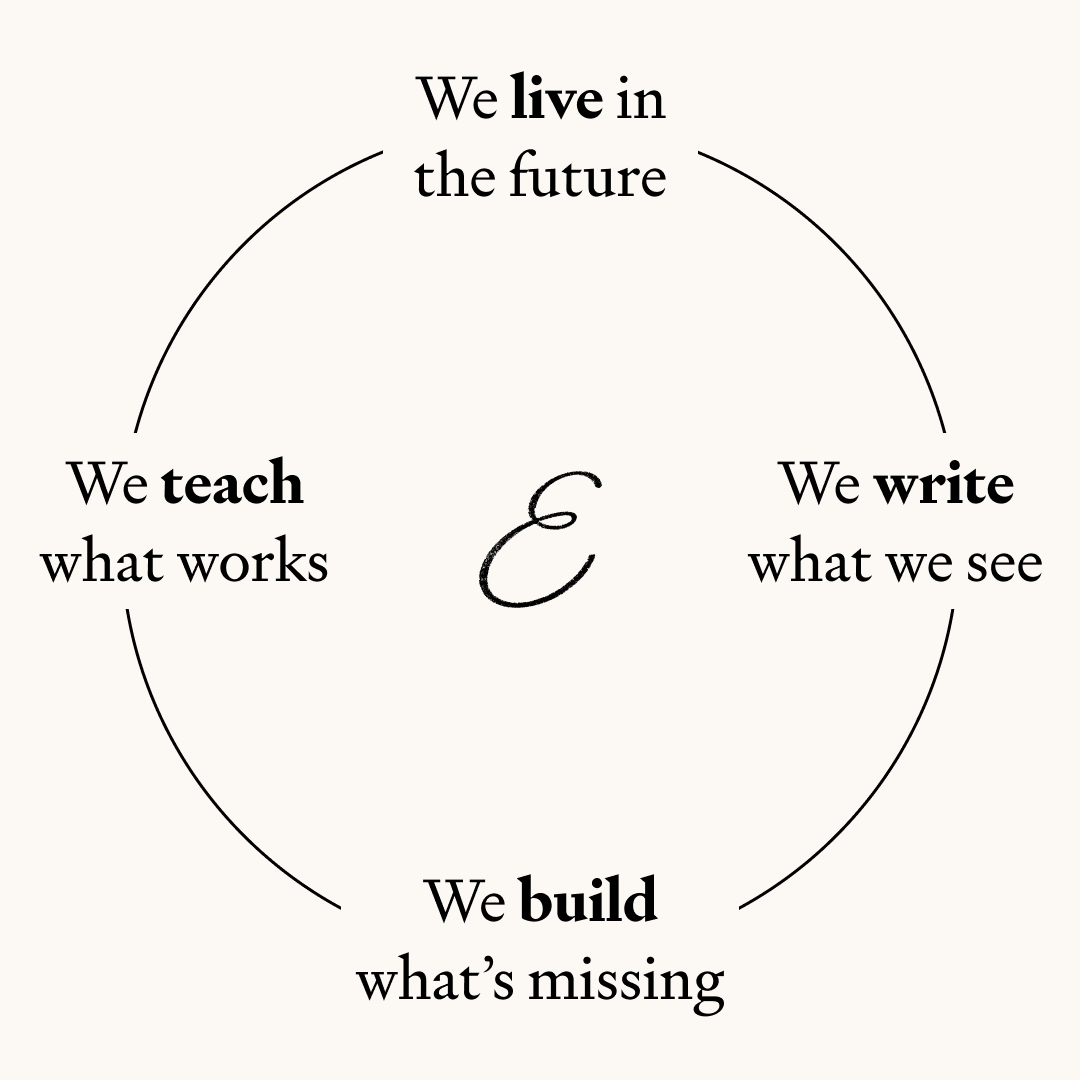
Experimentation with AI is the foundation of Every's business model. Their small team lives at the edge of AI, writes about what they see, and builds in the gaps they uncover. Shipper himself calls it a “weird” business model, but it's driving exponential growth: over 180K daily newsletter subscribers, 6 AI products built in-house with tens of thousands of active users, and forecasted to close the year at over $10M in annual revenue while growing 20% month over month.
Everyone inside the company builds with AI. As a result, the company's infrastructure footprint has grown organically as it’s scaled. In the early stages of the company, builders chose their own way to deploy their code, optimizing for velocity as they prototyped. In March 2026, a majority of Every’s workloads were on Railway. However, as Every’s growth accelerated and prototypes became real products with tens of thousands of paying users, the stakes increased, and cracks began to show in the platform they relied on.
Kieran Klaassen, General Manager of Cora, recalls: "I was building Cora on Render while others were on Railway. Over the years, I heard them talk about random outages and things breaking; it always seemed a bit unreliable. Meanwhile, everything was fine for me. It got to a point where the team said, 'ok, maybe we should just move everything over to Render.'"
A two-year POC in production
Unintentionally, Klaassen's experience building Cora became the proof of concept for Every's eventual move to Render.
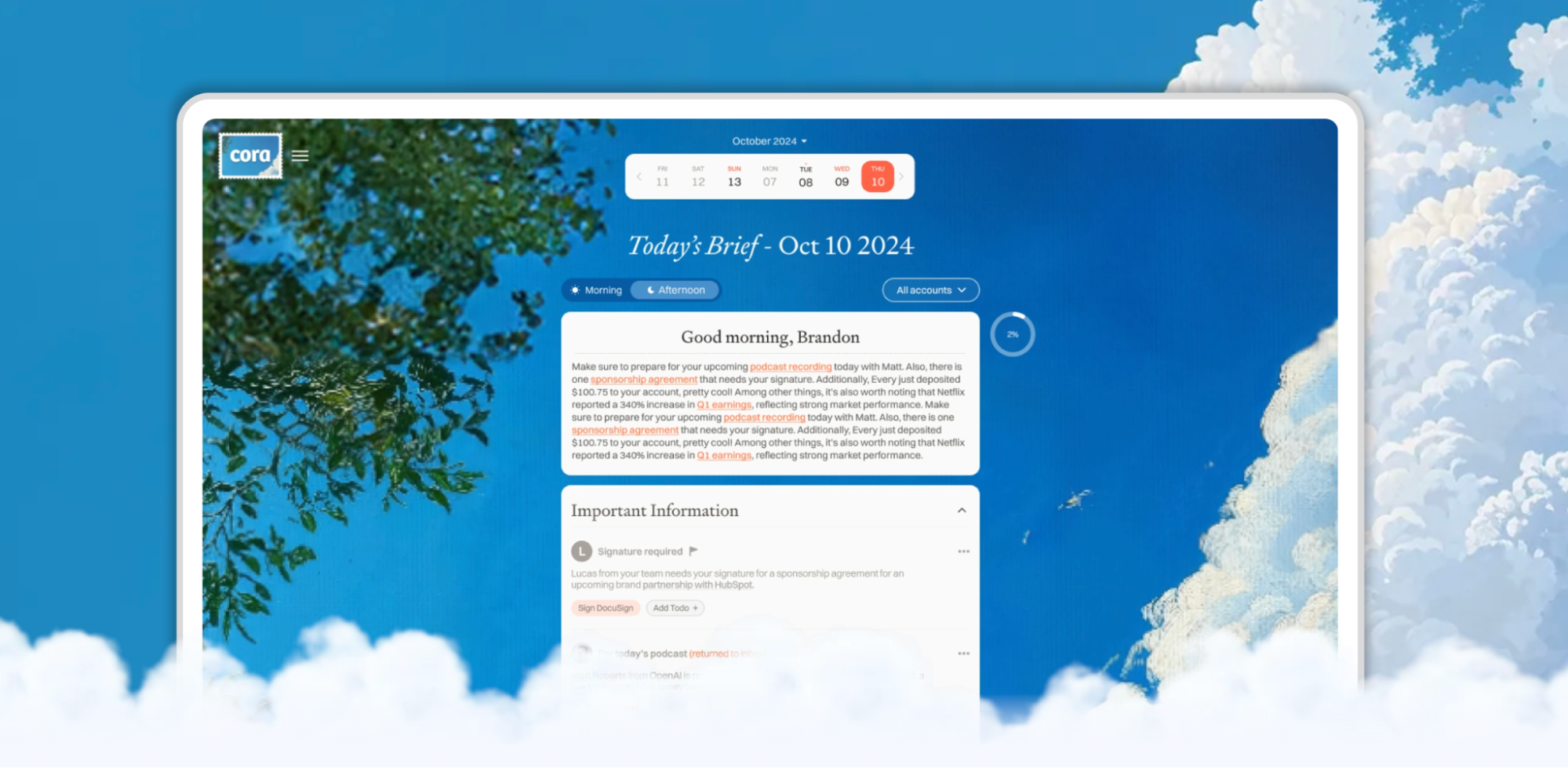
"I built the first prototype of Cora in an afternoon and deployed it on Render," Klaassen explains. "I had multiple other products with paying customers that had been running on Render for years without any problems. So, Render was my default."
As Cora gained traction, staying focused on shipping product was what mattered most to Klaassen. For the infrastructure behind it, all he cared about was that it stayed simple and stayed out of the way. "Render really does all of the things that I don't want to do," says Klaassen. “It handles the infra and the plumbing and lets me build whatever I want on top using my agents. Web services, workers, postgres—it all just works without being too opinionated. That's my style.”
Although Render's developer experience has the most impact on how Klaassen builds day-to-day, he still points to reliability as the primary quality he looks for in infrastructure and the reason why the rest of the Every team moved: "Normally, you choose something because it's exciting or cool, but in reality, you stick with infra because it's reliable. I had been telling the team for years, whenever there was an issue with Railway, 'Well, Render is still up.' Over the two years, I think I only ever had downtime once, for less than an hour, and it turned out that it was caused by Cloudflare, not Render."
The switch to invisible infrastructure
While Cora ran without incident, reliability problems accumulated for other Every products: random failures, unexpected downtime, and unclear communication that deteriorated trust. "We were frustrated because we were having downtime with Railway every few days,” recalls Brandon Gell, COO of Every and leader of their product studio. “For our team, nothing is worse than being slowed down by our tools or infrastructure. We wanted to move all of our infrastructure quickly and decisively. We didn’t need a long evaluation because we knew that Kieran had been running Cora on Render for years without any issues."
The migration moved quickly.
Naveen Naidu, General Manager of Monologue, moved Monologue’s services from Railway to Render through the Render CLI and Codex in roughly an hour. "Normal request latency looked strong, and app performance improved in a lot of places," he noted. "The Render CLI experience was great."
Every now runs all of its products on Render: Cora, Spiral, Sparkle, Monologue, Proof, and Plus One. They plan on moving Every.to by the end of the summer. Gell says that Every has “seen a dramatic improvement in reliability” since moving their workloads. “We’ve gone from having 3 or 4 issues every week to really not having to think about infrastructure at all.”

Building faster at the edge of AI
What infrastructure unlocks is harder to measure than uptime. It's the energy a team has left over at the end of a week. It's the speed at which a prototype becomes a product. It's the willingness to keep experimenting when experimentation is the entire business model.
For Every, the work that used to go into firefighting and maintenance now goes into the next experiment, the next product, the next piece of writing that surfaces an idea worth building.
"All of the writers are builders, and all of the builders write.” It's a model that only succeeds if the infrastructure underneath is an invisible extension of how you work. At Every, it finally is.

